
Is schooling injurious to health? §
The implicit curriculum and its relation to mental health
author: Matthijs Cornelissen
last revision: 1 July, 2015
Introduction
Educational theories and policies tend to include noble and inspiring ideals regarding “all-round development" of the students. The practice lives, however, rarely up to the intent. More often than not, the content of the curriculum and the manner in which it is transacted are such, that a negative effect on the healthy development of the students is almost inevitable. Children all over the world tend to spend a considerable part of their day in schools, and there are many good reasons why this is almost universally considered a good thing. Schooling is, however, not an unmixed blessing. There are many aspects of school life that can hardly be considered conducive to the healthy development of either child or teacher. This chapter attends to some of these factors, and suggests the direction in which a solution might be found.
Pathogenic elements of the implicit school curriculum
It is often said that what really matters in education is what remains once you’ve forgotten all they have tried to teach you. In its absoluteness, this is no doubt an exaggeration, but it is hard to overestimate the influence of what is known as the implicit curriculum: what children learn from the educational context, from the way the explicit curriculum is transacted. The effect from the educational environment is bound to be strong, if only because it hardly differs from year to year, or from subject to subject: It exerts more or less the same influence during each and every class, each and every day, each and every year a child goes to school. Given how many hours children spend in school, and how much importance they and their parents attach to this attendance, schools are thus rather likely to play a major role in “building the character” of the students. The question is, however, whether the type of character schools build is what the individual and the society really need. To get some grip on this question, we’ll look in the first part of this chapter at what Watzlawick, Bavelas, and Jackson (1967) called the pragmatics of communication. In other words, we’ll look at what happens to children when they attend school, not from an ideal or formal perspective, but from a pragmatic, psychological one.
The difficulties with what one could call the “standard school environment” are quite well known. They have been described with great insight over forty years ago by authors like Ivan Illich (1971) and John Holt (1964). It is also true that at least in Europe and North America, most nursery and primary schools do not follow this pattern any longer. But it is still holding out in the developing countries1, and its effects are likely to haunt humanity for many years to come. I’ll try to summarize here some of the most serious problems in as concise a form as I can. Interestingly, many of them arise out of the typical classroom layout.
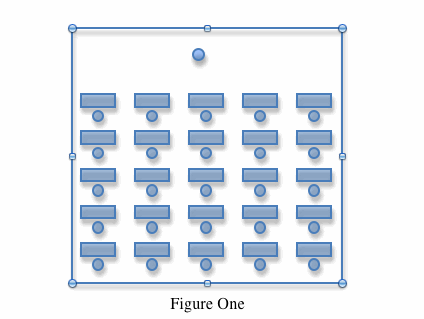
Figure 1. Neatly Ordered Desks
It is such a classic, with such widespread acceptance, that virtually every educated human being will immediately recognise Figures 1and 2 as a classroom: each child behind a small desk, the desks neatly ordered in rows, the teacher in front.
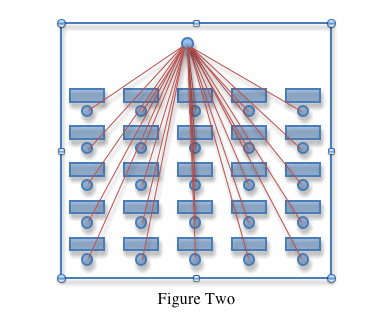
Figure 2. Lines of Vision
As Figure 2 shows, the arrangement allows (almost) all students to see the teacher, and the teacher, walking a little to the left and right, can keep an eye on every child. If education had been nothing but instruction, and learning nothing but a passive absorption of pre-digested knowledge, all would have been well. This, however, is not the case.
Pervasive lack of trust and harmony. The problems with the standard classroom layout arise mainly from the simple fact that it is not at all natural for children to spend their days sitting quietly behind little desks. The most visible victims of this arrangement are the increasing numbers of children with attention deficit disorder (ADD) who are nowadays routinely treated with drugs, while the vast majority of them would be quite fine with a bit more physical activity (and friendly hugs). The difficulties are, however, not limited to this increasing yet still relatively small group. They affect all children, and they seem to be due primarily to the antagonism that arises almost intrinsically between on the one side the children, who are forced to do what they don’t like, and on the other side the teachers, who are responsible for imposing the system. This antagonism forms the unpleasant backdrop for several educational practices that are bound to have a negative impact on the mental health of whole generations of human beings.
Promoting antisocial attitudes. The next and perhaps strangest thing about the standard classroom layout is that it inhibits communication between the students. Even when in a more economical arrangement students are grouped in twos on every bench, communication between them is still looked at as a disturbance, and, on many occasions, as cheating. In other words, to the extent that the students are obedient and conform to the system, they will learn to consider their peers (and to some extent even themselves) primarily as a potential source of conflict and disturbance. This is a highly peculiar, antisocial attitude towards self and others, and hardly something any well-meaning educationist would like to foster, but this is the attitude that flows naturally from the basic, physical set-up. The need to communicate with others is a very deep-rooted and irrepressible part of the human character. So suppressing this need for too many hours a day leaves children in a permanent state of inner conflict and unease, a state in which they have to be always on their guard, distrusting their own and their peers’ natural impulses. It is not hard to recognise traces of this unease in the adult population.
If a student does not accept this negative view of himself and his friends, he has very few options: the only simple way to stay loyal and close to his peers is to defy in one way or another the authority of the teacher. In other words, given the conflict that is built into the situation, the child can only remain socially connected by siding with the authority or by ganging up with the other kids against it. These are hardly attitudes the educational system can be happy to promote; and yet it does.
Competing for secondary gains: A corruption of the will. The traditional classroom set-up has another negative effect that has far-reaching consequences. The child has little to look forward to in the standard arrangement except for whatever little warmth and appreciation he or she can elicit from the teacher. The teacher, who has a large group of children to motivate, will be inclined to present this appreciation as a scarce commodity the students have to compete for. For the sake of convenience and “objectivity”, this appreciation then tends to get formalised as grades. As a result, children learn, systematically, during virtually every minute of their school-going life, to compete with their peers for the scarce and purely symbolic commodity of “top grades”, or, if they know they cannot manage this, at least for grades that are considered “sufficient”. In other words, they learn to do whatever the system demands in fierce competition with others, and in total disregard of more natural, more human sources of happiness and satisfaction.
Training incompetence. A quality that is exceedingly difficult to cultivate in the traditional classroom arrangement is individual initiative. Power, control and initiative are so completely centralised in the teacher, that even a well-meaning teacher can hardly create space for individual students to initiate their own work. Unfortunate as this is in its own right, it also has several untoward and entirely unnecessary consequences.
Teaching how to waste time. The most well known difficulty is that the uniform arrangement of the benches in the classroom makes it difficult for teachers to offer different assignments to students with different interests, learning styles and levels of capacity. Yet, if the teacher is incapable of providing worthwhile activities for different students at the same time, many of them will find it hard to find anything worthwhile to do. The less gifted children will learn to spend their time in an overwhelming, threatening environment, which they can neither understand nor control. The more gifted students will get bored, and as they can be rudely interrupted any time, they will find it safer to play silly games, than to do whatever they’re really interested in doing. Being stumped or playing meaningless games to pass time can hardly be habits teachers would like children to develop, yet this is exactly what the system encourages.
Trying the impossible. Interestingly even within the narrow range of behaviour that is both constructive and compliant, the scope for developing useful mental capacities and mental skills is small. If a teacher leaves half the period for student responses, and if there are less than 30 students in the class—and in most countries these are completely unrealistic conditions—each student can still hardly expect to speak for more than one minute during a one-hour period. Yet, active engagement is crucial for effective learning, and for language learning, the need to speak is essential. If a language is taught only during one period a day, then a-minute-a-period means a-minute-a-day, and this is obviously not enough to acquire mastery. As a consequence, in a traditional classroom setup there is simply no realistic possibility for children to learn a language that is not already spoken—and spoken well—at home. The same difficulty mars effective learning of many other skills or mental capacities a school is supposed to teach. Especially when student–teacher ratios are high (in Indian Government schools it is often 60:1) most of the actual learning has then to take place outside school hours with the help of parents and tutors, in other words, in situations where the student–teacher ratios are much, much smaller: a development which seriously hinders the aim of socioeconomic equality which compulsory universal schooling is supposed to serve.
Destroying the ability to make choices and take responsibility. In spite of what well-intentioned educationists and administrators may claim and hope for, and in spite of all the efforts individual teachers may make, the traditional education system, as a system, is still solidly syllabus-centred. Individuals and whole administrations may do their level best to introduce more activity-based learning and child-centred education, but in practice, teachers are still duty-bound to “transact the curriculum”, and they are judged on how well the students master its content. Once again, had schooling involved only a small part of a child’s life, all would have been well, but going to school is for most children a full-time job. As a result, students hardly get much of a chance to develop, for example, the all-important life-skill of making free choices in areas that really matter to them. Nor do they develop the ability to evaluate and take full responsibility for what they have chosen. (The one exception is the choice between compliance and defiance, but, as we discussed earlier, that choice has no satisfactory answer.) As they are not self-motivated to do what they are supposed to do in the class, they have to be cajoled into collaboration by a system of carrots and sticks. We saw already that in a more formal setting these tend to come in the form of grades; low grades as a deterrent, high grades as encouragement. Where the teacher has a strong and dominating personality, he or she may manage to get a class to do what he or she wants even without using grades, but the principle remains the same: the children learn to do whatever is asked from them as long as it delivers the secondary rewards they have learnt to seek for.
Training opportunism: A corruption of the mind. The habit of working for secondary gains has a deeply corrupting influence in the area of motivation and will, but when this secondary gain is based on the evaluation of one's work, the corrupting influence extends to the area of perception and judgment. When evaluation is used as motivator, there arises in the child an in itself quite erroneous perception that there is an inherent conflict between what is desirable and what is true. This is, of course not to claim that that conflict never arises naturally, but when evaluation is persistently used as the main source of motivation, it is kind of hammered into the child’s mind that there is a conflict between what is true and what is pleasant and the child is almost bound to conclude that this conflict is inherent and pervasive. When evaluation is used as motivator, the corruption that takes place has its effect on both sides of the equation: on the side of the motivation that leads to the action, and on the side of the evaluation that follows the action. In other words, there is then not only the subversion of a child’s natural eagerness to learn, but there is also a direct attack on the child’s willingness, and subsequently ability, for impartial judgment of his own actions. To say it somewhat plainly, it is hard to be honest if there is too much self-interest at stake.
Teaching narrow-mindedness. This pressure in the direction of opportunism is greatly reinforced by constant evaluation. The fact that children are continuously judged on criteria that are not of their own making conveys at least two implicit messages: (a) There is a clearly defined right and a wrong way of thinking and doing things, which is implied by the fact that if this were not the case, the entire evaluation process would lose its meaning and validity; (b) What is right and what is wrong cannot be determined by the student but is decided either by the teachers or by “the system”, something rather vague and unaccountable that’s even above their teachers. It is hard to accept that blind faith in “higher-ups” and “the system” is an acceptable outcome of a sane system of education.
Training underperformance and opportunism. There is another, more subtle problem with the imposition of a fixed syllabus. Teachers often ask questions to their students. These questions, however, are only rarely genuine questions in the sense that the teacher doesn’t know the answer to his own question. Teachers are taught to ask, as much as possible, open-ended questions. Yet, even when they do so, these seemingly “open questions” are hardly ever about something that is genuinely open to a variety of different answers. Almost always, the teacher knows the “correct” answer beforehand and asks the question only to check whether the students can produce that specific answer. This can create for the students a number of difficult dilemmas, for which only a few can always find constructive answers. The nature of the dilemma depends on whether the question is about facts or opinions. The border between facts and opinions is of course fluid, and to quite an extent a matter of attitude. Some people live in a world where almost everything is definite and well defined this way or that. Others live in a much more fluid world where “it all depends”. For most children, the difference is clear—there are things that are straightforward, like maths and geography, and other areas, like values, relationships and feelings, where it is far more difficult to be sure of what is “right” and what is “wrong”.
- Training underperformance.When the question is “factual”, in the sense that there actually is, or at least seems to be one clearly correct answer, the situation is still comparatively simple. John Holt has described with great perspicuity what happens in such situations. Those children who are considered bright by the teacher—and by themselves—make a genuine attempt at producing the right answer. They trust that even if they get it wrong, they will still be treated with respect on the basis of their standing reputation. John Holt observed that in fact, such students are often given a second chance. Those children, however, who are considered dumb by the teacher—and often by themselves—cannot trust at all that they will be treated so generously. They have, first of all, a greater chance of making a mistake, and they suspect, often correctly, that if they get it wrong, they will be derided in front of the whole class. Doing your best and then losing can be pretty frustrating, so they are tempted to avoid the risk. They tend to try this first by getting at the correct answer by stealth, and if this doesn’t work, they may give, on purpose, a wrong answer. The incorrect answer does of course guarantee defeat, but the shame of the defeat is compensated for by the satisfaction of having been in charge of the entire chain of events leading to it. Though the teacher has the apparent victory, the student knows that behind the scene, it is the student who has pulled the strings. Making such negative choices is obviously disastrous for the intellectual growth of the child, but anecdotal evidence suggests that it is fairly common. Once this habit has established itself in a child, it is not hard to imagine how easily this habit can invade other areas of life and how disastrous the results can be.
- Training opportunism: A corruption of the mind. When the answers do not have one factual answer, the situation gets more complex. The question that then arises is what the child should do when the answer that comes up in her own mind differs from the one the teacher expects. If the child is very clever, she can keep the two separate by giving the teacher what he expects while remembering and treasuring her own answer. This is however rare, and the few children who manage it tend to come from homes where they get full support from their parents to keep up their own individuality. For most children this is not the case, and so they are faced with an existential dilemma. If they stick to their own answer, they are in trouble because most teachers assume that answers that differ from those in the textbook are wrong, and that children who give those "wrong" answers must be recalcitrant, stubborn, uncooperative or simply unintelligent. For most students, compliance is thus far more likely to lead to attractive results, and so the vast majority of them gives in, and tries to answer what the teacher wants to hear. Now this is once more far more nefarious than it may look at first sight, for what happens is somewhat similar to what happens when evaluation is used as motivator: the child learns to suppress what he thinks is true, for the sake of what is convenient. To look at it from a slightly different angle, the child is trained to be other-directed (if not plain opportunistic), and in the process gradually loses the ability to distinguish for himself what is true and false.
To summarize...
To summarize the argument so far, the traditional classroom arrangement in combination with a fixed syllabus and continuous evaluation virtually prohibits learning how to build constructive relationships, how to respect differences between people, how to feel at ease with oneself and others, how to recognise one’s own and others’ strengths, how to pool these for a good common cause, how to make one's own value judgements and work constructively together towards some meaningful end. It breeds opportunism and a tendency to work for secondary gains. It encourages underperformance in the weaker students, and it teaches the more intelligent ones how to waste time...
One could well argue that this is a caricature, and that good teachers can manage to create an atmosphere of cooperation and common purpose even in a traditional classroom. This is no doubt true, but to the extent that this succeeds, it is an individual achievement, which is brought about in spite of the system. The factors mentioned above still play their antisocial and pathogenic role as undercurrents inherent in the system.
Is there an alternative?
Fortunately, there are effective and viable alternatives to the type of authoritarian schooling described above. For an out-dated but still interesting exposition, one could consult for example Freedom to learn for the Eighties (Rogers 1983), which contains an insightful discussion of the reasons some experiments succeeded while others failed. My own experience with the development of a radically different approach to education at Mirambika (a centre for learning based on Free Progress Education as outlined by Sri Aurobindo and The Mother) has convinced me that it is quite well possible to design and implement a system of education in which all participants—students, teachers and management—learn and grow as human beings while staying true to themselves. For an excellent third person assessment of this project, see Raina and Sibia (1999) or, on this website:
- Sibia, Anjum (2011). Life and learning at Mirambika.
Anjum Sibia is a professor at the NCERT (the National Council of Educational research and Training, Govt. of India), and this article is based on her PhD. It uses the ethnographic methods of detailed observation and extensive triangulation to examine the teaching-learning process in Mirambika as it actually happens.
The underlying theory and the psychological processes involved in Integral Education, one can find here; it is written by one of its founders and its first principal:
- Huppes, Neeltje (2011). Integral education: An application of Indian psychology
For a much more detailed description of the involved processes, inclusive extensive practical guidance on how to prepare for such a system of education, both in oneself and in the classroom, one could consult, also online:
- Huppes, Neeltje (2004). Psychic Education: A workbook based on the writings of Sri Aurobindo and the Mother (PDF file, 294 pages).
This book is a practical guide for teachers and trainees at Mirambika. Over time it has proven invaluable for many who are serious about their spiritual growth, and who want to implement spirituality in their daily life and work, whether inside or outside the field of education.
Comparing our own work with that of others, it looks to me that the basic, underlying principle of such alternatives is so utterly simple, that it is almost embarrassing to mention it. Over the years we have asked hundreds of psychologists, teachers, educationists and parents about their strongest memories from their own school-going years. Interestingly, both, their best and their most painful experiences, had almost always to do with the presence or absence of respect from the side of their teachers. In other words, the one thing needed to improve education is respect from the teachers for the students. The only additional condition is that this respect must be genuine, soul-based and applied systematically and rigorously to all aspects of the educational enterprise. Unfortunately, this requires an extremely radical change in the whole system. Not only the pragmatics of the educational process has to change, but also the attitude of the teachers, and, as we will see, even the basic methodology underlying the science of psychology. And all this is far from trivial.
In an ideal world, the whole system of education should be built on such respect, but in practice it hardly is. It is true that even if the system as a whole is not, individuals can sometimes still keep up the right spirit, but it is not made easy for them. For one single teacher, for example, it is exceedingly difficult to do good work within a school system that does not support it. From our experience it appears that the minimum grouping in which genuine educational reform can take place consists of one or more good teachers, a willing principal and a supportive management, but much depends of course on how much freedom the local laws and culture allow.
For a solution on a larger scale we are confronted with a peculiar problem that has to do with the initial qualifiers: the respect must be “genuine and soul-based”, but what is that? As an innocent, naive human individual, I “kind of know” what “genuine” and “soul-based” mean, but is there place for such ethereal concepts in science, and thus in public life? To answer this question we have to have a look at the very foundations of science and the role science has played, and still plays, in education.
Education and the scientific method
A highly respected professor in Educational Innovation once told me in total earnest that whatever can be researched is useless for educational practice, and that whatever really matters in education is beyond the scope of research. As he was clearly committed to the field of education, I asked him what made him stick to his job at the University. His response was that because of the research he did at the University, people believed what he said in public lectures and Government Committees, but that what he said there was not at all based on the kind of research he did. I thought this was rather shocking, and one could probably argue that his low opinion of research in education is exaggerated, but many in the field will recognise the basic problem. I have no scientific proof for any of the negative effects of schooling on mental health that I have discussed in this chapter. This is, however, not for want of trying: the problem is that scientific proof in fields like mental health and education is extremely difficult to achieve, and, like many of the things mentioned in the first half of this article, this has far more serious consequences than most people seem to realise.
There can be little doubt that science has become the official knowledge system of our global civilization, and within science, it is psychology that is responsible for the study of human nature. Psychology is thus the fundamental science on which our educational methods are based, but the science of psychology as presently understood and practiced is, I'm afraid, not fit for purpose. I'm fully aware that this is a serious accusation, and I'm not making it lightly. The basic problem is that modern psychology tries to be objective, and as a consequence, it has great difficulty dealing with things that are quintessentially subjective, yet absolutely central to most people's lives, things like meaning, truth, beauty, love. If psychological research cannot deal with things that for many of us are the essence of what life is all about, and when it is considered irrelevant by key players in the field, we do have a very serious problem, and we must at least try to find out why we are in this mess and what we can do about it.
Issues of epistemology and methodology are complex and in the social sciences the subject of much debate, but it may still be interesting to attempt a very short overview of the main difficulties and possibilities, as these may give us a hint on how education might be taken forward in a more wholesome direction. Our present predicament started with behaviourism. The behaviourist approach, which is still responsible for the bulk of psychological research, is by choice and definition limited to external behaviour. In its early forms, it had thus very little to say about most of the invisible things that are important in education and that make human life worth living: things like consciousness, love, feelings of awe and wonder, values, and even meaning itself. Strangely, and I would say tragically, this did not prevent it from dominating research in education.
Again, one needs to get down to the nitty-gritty to see what this meant in practice. Many of our modern learning theories have their origin in animal experiments in which rats, mice and pigeons are taught to produce arbitrary behaviour by presenting them with the right regime of rewards and punishments.2 In such experiments the “negative reinforcement” typically consists of electrical shocks given to the animal’s feet or tail; the “positive reinforcement” consists of food-pellets; and “motivation to learn” is regulated by depriving the animal subjects of the positive stimulus beforehand, so that it can quantified as the difference between their “free feeding weight” and their actual weight. There are many reasons to object to such studies, but the most serious problem with them is that they were generalised mindlessly to learning in children. The result was a strong endorsement of educational practices which replace the natural learning of children, which consists of happy, playful attempts at making sense of their existence in the world, by learning of for the child arbitrary, meaningless facts under pressure of a reinforcement regime that consists of deprivation, punishment and secondary rewards. In other words, children are taught systematically, throughout their formative years, to do meaningless things in order to obtain “incentives” in an overall climate of deprivation, and this is not a minor, innocent error. Though hard to prove or quantify, it seems likely that this has contributed considerably to the alienation and the obsessive production and consumption that is the bane of our global civilization.
Of course, science does not stand still and there has been considerable progress since the heydays of classical behaviourism. The work of the constructivists, and especially Piaget, has considerably improved the foundations of modern psychology, but it is not enough, because the soul, the core of our human existence, is still missing.
There is by now quite a lot of literature on how science could change in a direction that would allow it to study inner, spiritual realities in a serious, rigorous manner. Some initial material is available on the Indian Psychology Website at its "Integral Indian Psychology Resources" page. We are working on making these lists more complete.3
Conclusion
I hope to have shown in a perhaps unscientific but nevertheless convincing manner that there are quite a number of common practices in mainstream education that deserve to be described as deleterious to mental health, both at the individual and the collective level. Though cause and effect are difficult to assess in the social domain, there seems to be a direct link between those practices and some of the most serious ills that beset our global civilization. Eugene Taylor (1999, pp. 289–296) argues in Shadow Culture, his insightful book on the relation between spirituality and science in American history, that we can expect to see a growing influence of Indian ideas on the developing global civilization, and especially a major shift in its basic epistemological assumptions, away from materialism and in the direction of Indian spirituality. If Taylor is right, and science does indeed move in this direction, then it may finally be able to help us develop the genuine, soul-based respect that our children need.
Endnotes
§ The provocative title of this article originated during a discussion with Larry Dossey, in which he shared some impressive scientific evidence suggesting that the psychological practices used in standard, mainstream schooling have a larger negative impact on physical health, than smoking and heredity combined. As we talked, we happened to pass by one of New Delhi's best private schools, and we wondered how it would look if schools would be compelled to fix a large statutory warning above the entry asserting, "SCHOOLING IS INJURIOUS TO HEALTH". Somehow that image never left me.
1 It is interesting to speculate why, up to very recently, schools in countries like India have changed much less than similar schools in Europe and America. One reason might be that in India, the English system of education was not home-grown but imposed from the outside, with the result that teachers didn't feel that they "owned" the system: they had the duty to execute it, but not the authority to change it. It is only in the last few years, since India is recovering her economic and political self-confidence that local educators have begun to feel that they have the power to make radical changes.
2 There are far too many of such researches to mention them individually, but typical examples are Leslie (1977) and more recently, Baum (2010). The latter starts with a stunningly flippant generalisation from the actual experiment on pigeons to human decision taking.
- From my side, there is:
- A more detailed analysis of the various paradigms and their consequences for personality theory can be found in:
- And still another perspective on the different knowledge modalities that science should allow inside its compass:
2007: In Defence of Rigorous Subjectivity
This article gives the basic argument why rigorous, yoga-based, research of first person experience is necessary to take Psychology further. It is based on a keynote given at the Annual Conference of the Transpersonal Psychology Section of the BPS in 2007.
2011: Types of knowledge and what they allow us to see: How our research methods affect the quality of our psychological understanding.
2009: What is knowledge? A reflection based on the work of Sri Aurobindo.
This article looks from an experiential angle at the different types of knowledge that are involved in yoga-based research. A slightly shorter version has been included in Matthijs Cornelissen, Girishwar Misra and Suneet Varma (eds.) (2014), Foundations and Applications of Indian Psychology. New-Delhi: Pearson.
References:
Baum, W. M. (2010). Dynamics of choice: A tutorial. Journal of the Experimental Analysis of Behavior, 94(2), 161–174. doi: 10.1901/jeab.2010.94-161.
Cornelissen, R. M. M. (2011). What is knowledge? Reflections based on the work of Sri Aurobindo. In R. M. M. Cornelissen, G. Misra, & S. Varma (Eds.), Foundations and Applications of Indian psychology. New-Delhi: Pearson.
Cornelissen, R. M. M. (2007). In defence of rigorous subjectivity in Transpersonal Psychology Review, 11(1), 8–18.
Cornelissen, R. M. M. (2006). Research about yoga and research in yoga: Towards rigorous research in the subjective domain. Retrieved from https://ipi.org.in/texts/matthijs/mc-researchinyoga.php.
Holt, J. (1964). How children fail. New York: Pitman Publishing Company.
Huppes, Neeltje (2011). Integral education: An application of Indian psychology. In R. M. M. Cornelissen, G. Misra, & S. Varma (Eds.), Foundations and Applications of Indian psychology. New-Delhi: Pearson.
Huppes, N. (2002). Psychic education: A workbook. New Delhi: SAES. [The book is presently out of print. A pdf file of this book is available at: https://ipi.org.in/texts/neeltje/psychedu-all-10a.pdf.]
Illich, I. (1971). Deschooling society. New York: Harper & Row.
Leslie, J. C. (1977). Effects of food deprivation and reinforcement magnitude on conditioned suppression. Journal of the Experimental Analysis of Behavior, 28(2), 107-115. doi: 10.1901/jeab.1977.28-107.
Lorimer, D. (2001). Thinking beyond the brain. Edinburgh: Floris Books.
Nagel, T. (1986). The view from nowhere. New York: Oxford University Press.
Raina, M. K., & Sibia, A. (1999). Schooling in Mirambika: A case study. New Delhi: NCERT.
Sibia, A. (2011). Education for life: The Mirambika experience. In R. M. M. Cornelissen, G. Misra, & S. Varma, (Eds.), Foundations and Applications of Indian psychology. New Delhi : Pearson. [The article is available on this website at https://ipi.org.in/texts/others/anjum-fip-edu.php.]
Skinner, Q. (1985). Introduction: The return of grand theory. In Q. Skinner (Ed.), The return of grand theory in the human sciences (pp.1-20). Cambridge: Cambridge University Press.
Taylor, E. (1999). Shadow culture: Psychology and spirituality in America. Boston: Counterpoint.
Watzlawick, P., Bavelas, J. & Jackson, D. (1967). Pragmatics of human communication: A study of interactional patterns, pathologies, and paradoxes. New York: W. W. Norton & Company.